
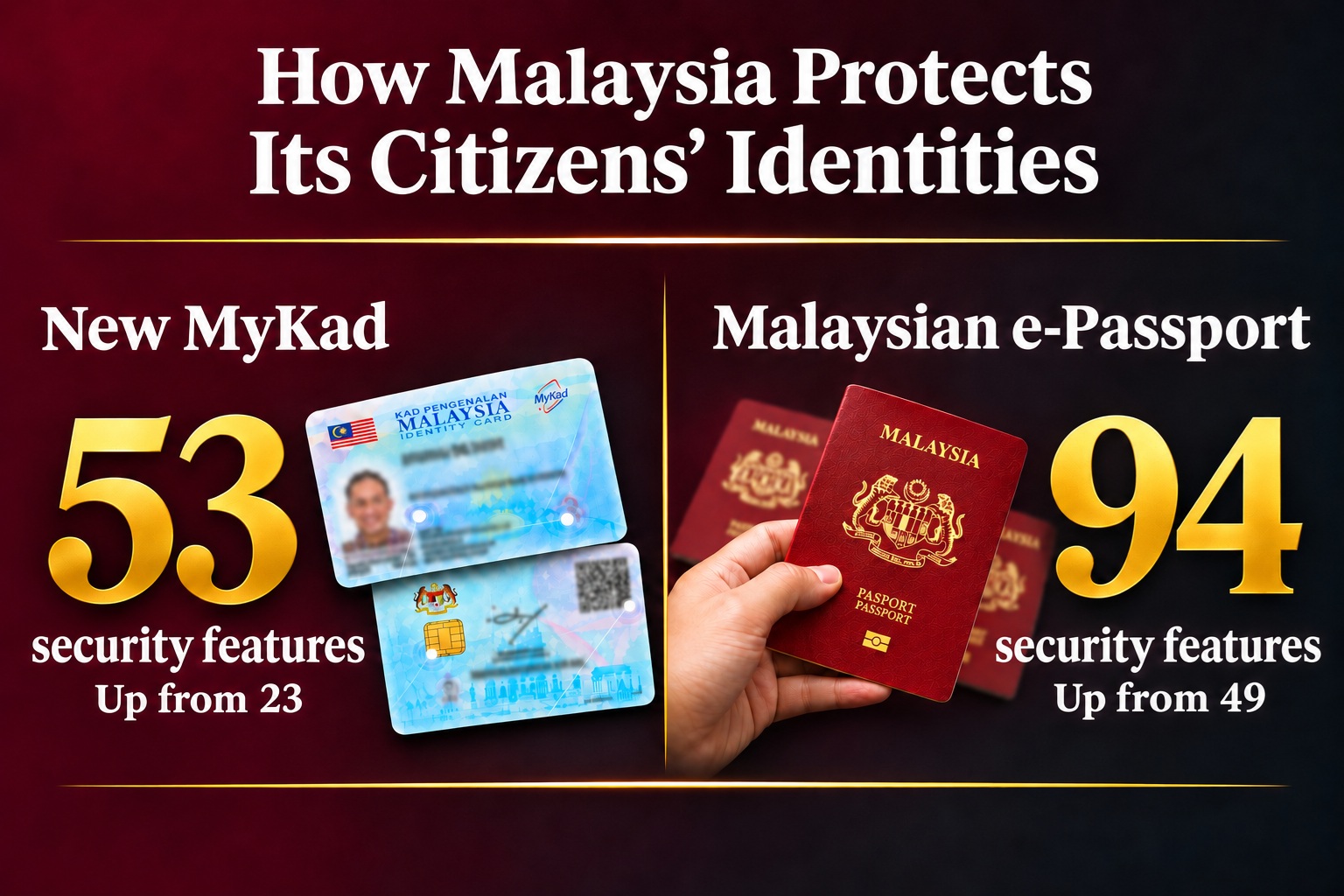
The new-generation MyKad, first introduced on 17 September 2026, reportedly has 53 security features, up from 23 in the previous generation. Malaysia’s e-Passport reportedly incorporates 94 security features across its booklet, polycarbonate biodata page and electronic chip.
The upgrades are part of Malaysia’s ongoing efforts to secure its identity and travel documents against increasingly sophisticated identity theft, document forgery and cybercrime. For citizens, these features can make fraud harder, protect personal information and help authorities verify the documents when they are used.
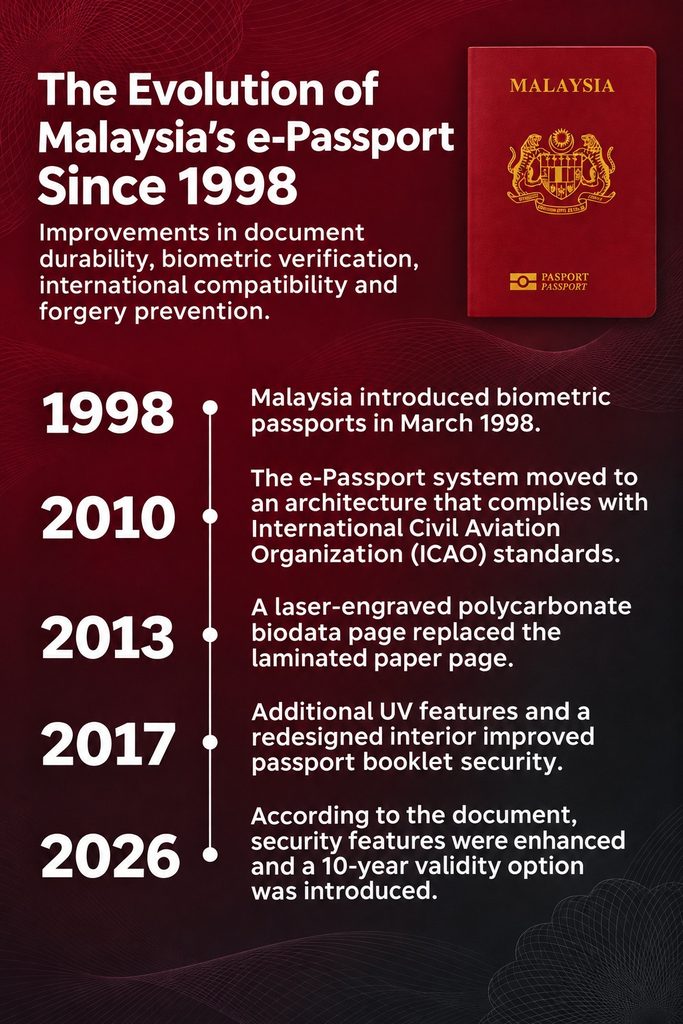
Malaysia has a long history in this field. It introduced the world’s first biometric passport in March 1998, followed in September 2001 by MyKad, the world’s first chip-based multipurpose national identity card.
The new MyKad combines physical and digital safeguards
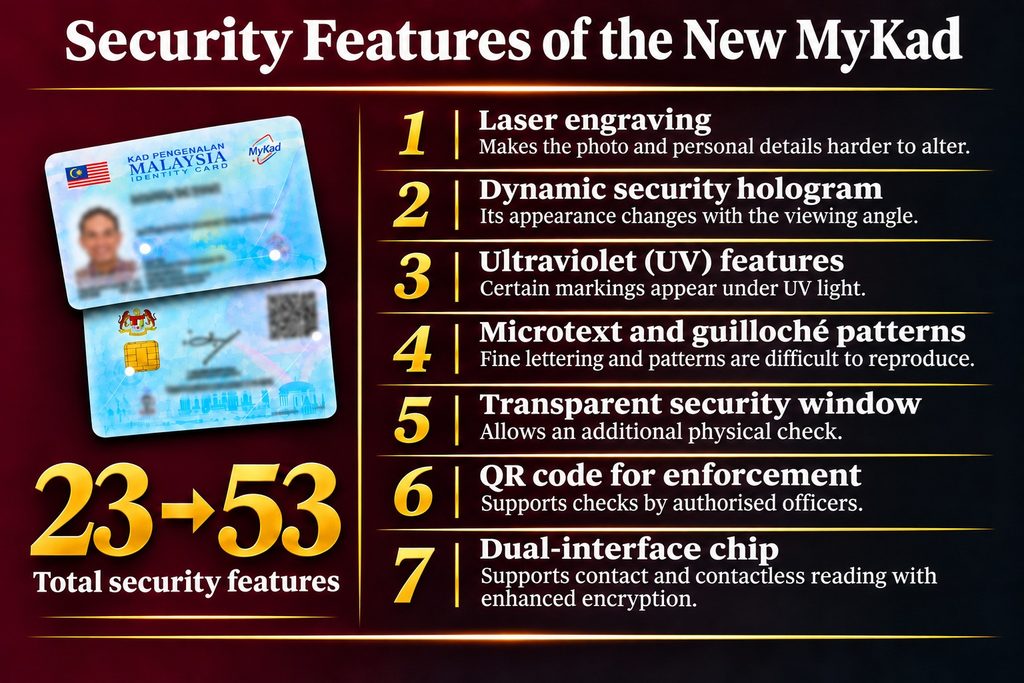
Increasing the number of security features from 23 to 53 brings several methods of verification together in a single card. They include the following.
- Laser engraving. Photographs and personal information are permanently engraved into the card material, making unauthorised changes or tampering more difficult.
- Dynamic security holograms. The visual effect changes with the viewing angle, helping officers distinguish genuine cards from counterfeits.
- Ultraviolet (UV) security features. Certain markings and patterns appear under UV light, providing another way to check the card’s authenticity.
- Microtext and guilloché patterns. The tiny lettering and intricate geometric patterns are difficult to reproduce accurately with ordinary printers or scanners.
- Transparent security window. A specially designed transparent element gives officers another way to check the card physically and makes it harder to imitate.
- QR code for enforcement checks. The machine-readable code supports checks by authorised officers, subject to the authorities’ security controls and verification systems.
- Enhanced dual-interface microchip. The chip supports contact and contactless communication, with improved encryption and authentication capabilities to protect sensitive information.
The new MyKad retains its multipurpose design. Alongside its role as the national identity card, its embedded chip and associated verification systems support other authorised applications.
Malaysia’s e-Passport has evolved since 1998
Malaysia has upgraded its biometric passport in several stages to improve durability, strengthen biometric verification, support compatibility with international inspection systems and make forgery more difficult.
The 94 reported security features are distributed across the passport booklet, biodata page and chip. Together, these components make counterfeiting, alteration and unauthorised duplication more difficult.
Polycarbonate makes passport biodata harder to alter
The polycarbonate biodata page consists of several layers of durable polymer bonded together. Laser engraving permanently embeds the holder’s photograph, personal details and selected security elements into the material.
This construction makes it harder to alter the photograph or personal details without leaving visible damage. Polycarbonate is also more resistant to wear, helping the biodata page remain in good condition throughout the passport’s validity period.
At border checkpoints, electronic verification supports physical inspection. The embedded contactless chip stores the holder’s identification and biometric information. Verification mechanisms recognised by the International Civil Aviation Organization (ICAO), including Public Key Infrastructure (PKI), help border authorities confirm the authenticity and integrity of that data.
Digital signatures allow authorised inspection systems to detect changes to signed information. Additional access controls and authentication mechanisms help protect sensitive information from unauthorised reading or manipulation. These capabilities support immigration checks, including electronic passport verification and automated border gates.
Datasonic has supplied MyKad since 2001
Datasonic Group Berhad has helped develop, supply and upgrade the infrastructure behind MyKad and Malaysia’s passport through its subsidiaries and technical teams in Malaysia.
Its work covers secure document components, equipment for personalising documents with the holder’s details, operating systems, biometric technology and related technical services.
Datasonic’s involvement in the MyKad programme began in 2001. Its passport work expanded after it secured contracts to supply polycarbonate biodata pages and passport personalisation systems in 2012, followed by contracts for passport chips and booklets in 2015.
The Ministry of Home Affairs subsequently awarded Datasonic new six-year contracts for passport and MyKad supplies and services, covering 1 June 2026 to 31 May 2032, according to the technical document.
The contract period provides scope for continued investment in research and development, Malaysian technical expertise, manufacturing capabilities and security innovation. Datasonic’s responsibilities over that period also include rigorous quality assurance, controlled production environments, cybersecurity controls, reliable delivery and ongoing technology improvements.
Document security starts before issuance
Laser engraving, holograms and chips are part of a broader system. Personal data must be protected from the moment it is processed, document materials must be controlled during production, and officers need reliable equipment to verify documents. The technical document outlines five layers of protection.
- Physical security covers document materials, laser engraving, holograms, UV elements and anti-tampering technology.
- Electronic security includes secure chips, encryption, digital signatures and authentication protocols.
- Production security requires controlled facilities, safe handling of materials, tight inventory controls and comprehensive audit trails.
- Cybersecurity protects document personalisation systems, databases, communications networks and sensitive personal information.
- Operational security depends on trained local staff, reliable verification equipment, regular updates and effective monitoring.
Together, these layers make it harder to forge documents, compromise personal data or exploit weaknesses in identity systems. Their effectiveness also depends on Malaysia’s ability to safeguard its accumulated technical knowledge, proprietary systems and sensitive national data.
International technology partnerships can provide expertise and specialised equipment. Malaysia can strengthen the long-term benefits through meaningful technology transfer, local research and development, and the participation of Malaysian engineers and specialists in building these capabilities.
The figures of 53 and 94 show the scale of the upgrades to two important national documents. The real test is whether citizens can use them with confidence, authorities can verify them consistently, and Malaysia can continue to protect personal data and strengthen its technological capabilities.